Which Arabic Should You Learn? The Complete Guide to Classical Arabic, MSA, and Dialects
Arabic is not one thing. Your study plan should reflect that.
Over the past twenty-five years, Qasid Arabic Institute has had the privilege of working with thousands of students from around the world: undergraduates preparing for a semester in Jordan, researchers working through premodern texts, diplomats and development professionals, heritage learners reconnecting with a language spoken at home, and people drawn to Arabic simply by faith, literature, or curiosity. They arrive smart, disciplined, and hungry to learn, and if anything, they have shaped our curriculum and teaching more than we have shaped them.
What most of them share is seriousness. They attend class, review vocabulary, complete assignments, and give Arabic the kind of sustained effort that should, by any reasonable measure, produce results.
Often, it does. But not always in the way they expected.
A learner may spend a year becoming genuinely capable at formal reading, then feel oddly helpless in an ordinary conversation. Another becomes socially at ease in Amman and still cannot follow a newspaper article. A student of Classical Arabic may build an impressive command of grammar and still read slowly, translating sentence by sentence in their head. A learner trained mainly in Modern Standard Arabic may discuss elections and international policy fluently while lacking the language for the small, unremarkable exchanges that daily life is actually made of.
In hundreds of classroom conversations and one-on-one academic advising sessions, in person and online, we have seen this same pattern recur. Dedication and hard work matter enormously, but they are not sufficient on their own. What's usually missing is direction, a clear sense of what a student is studying, why a particular sequence of study serves their actual purposes, and what kind of Arabic their desired future genuinely requires.
For years, we addressed this mainly through the academic orientation we give incoming students each quarter with material drawn less from our own invention than from research in historical linguistics, second-language acquisition, educational psychology, and even sports psychology. We have since come to think that most Arabic learners don't need another list of study tips so much as a clearer map of the terrain:
(1) what Arabic actually is,
(2) what they're trying to do with it, and
(3) how progress through it tends to unfold.
This piece, the first in a long series, is our attempt at that map.
I’d like to describe what happens next as a kind of puzzle. In the beginning, a learner simply connects whatever pieces happen to fit: a vocabulary word here, a grammar rule there, without any real sense yet of the larger picture those pieces belong to. That's not a mistake. It's simply where everything starts. But at some point, it helps enormously to look at the box the puzzle came in, to know what the finished picture is supposed to resemble.
The central proposition of this article is quite simple:
Before asking how to study Arabic, ask what kind of relationship with Arabic you are trying to build.
That question won't answer everything on its own. But it will change what counts as a sensible place to begin, a productive use of your time, and genuine progress.
What Is Arabic?
Spend five minutes in the comments under almost any of our social posts about Arabic dialects, and you'll see the question answered a dozen different ways, usually all at once and usually with some heat behind it. Someone insists real Arabic is the Qur'anic register and nothing else. Someone else insists no one actually speaks that register, and that the "real" language is whatever people use at home. A third person is certain we have left out their own dialect on purpose. We were even recently labelled as being too Levantocentric, of treating Shaam, Amman and Palestine as the default and everything else as a footnote. People get remarkably worked up over a question most of them have never had to answer out loud before.
We don't think that reaction is silly. If anything, it's a sign the question deserves a real answer before anyone spends years of their life studying toward it.
In one of his letters to Lucilius, Seneca writes:
ignoranti quem portum petat nullus suus ventus est — for the one who does not know which port he is making for, no wind is favorable.
A strong wind only helps you if you already know where you're headed. Take the destination away, and effort and progress stop being the same thing. The same wind may carry one ship toward harbor and another away from it.
A learner preparing for archival research needs a different early emphasis from a learner about to live with a host family in Jordan. A journalist following political debate needs a different balance from a student hoping to read al-Ghazali or al-Jahiz. A physician working with Syrian refugees, an anthropologist interviewing people in Morocco, and a heritage learner hoping to speak naturally with grandparents may all be “learning Arabic,” but the phrase conceals almost as much as it reveals.
Without a destination, learners mistake intensity for direction. Because the work is difficult, they assume it must be taking them toward the Arabic they want. Months or years later, they discover that the abilities they have built do not match the situations in which they hoped to use them.
In the classical logical tradition, before you can judge whether something is true or useful — that is, before tasdiq, or judgment — you first need tasawwur, an adequate conception of the thing itself, sometimes translated as "simple apprehension." You cannot reasonably assess a claim about Arabic, or plan a course of study around it, if your mental picture of "Arabic" is still hazy. So before we talk about how to study, or what the experience will feel like, or which methods work best, we want to answer something more basic: what, exactly, is Arabic?
A House We Did Not Build
In the tenth century, the grammarian Abu al-Qasim al-Zajjaji recorded a report about al-Khalil ibn Ahmad al-Farahidi, the early scholar of Arabic lexicography and prosody and the teacher of Sibawayh. Asked whether his grammatical explanations had been transmitted directly from the Arabs or developed through his own reasoning, al-Khalil compared the grammarian to a wise visitor entering a house of remarkable construction.
فمثلي في ذلك مثل رجل حكيم دخل داراً محكمة البناء؛ عجيبة النظم والأقسام؛ وقد صحت عنده حكمة بانيها، بالخبر الصادق أو بالبراهين الواضحة والحجج اللائحة، فكلما وقف هذا الرجل في الدار على شيء منها قال: إنما فعل هذا هكذا لعلة كذا وكذا، ولسبب كذا وكذا. سنحت له وخطرت بباله محتملة لذلك، فجائز أن يكون الحكيم الباني للدار فعل ذلك للعلة التي ذكرها هذا الذي دخل الدار، وجائز أن يكون فعله لغير تلك العلة، إلا أن ذلك مما ذكره هذا الرجل محتمل أن يكون علة لذلك. فإن سنح لغيري علة لما عللته من النحو هو أليق مما ذكرته بالمعاول فليأت بها
If a wise person were to enter a house of sound structure, of marvelous form and proportion, whose builder’s wisdom appeared correct to him according to reliable information, the unmistakable lines of proof and clear arguments. And each time the man stopped and pondered a part of the house, he said, “[the builder] did it this way for such and such a reason and such and such a cause.” That is what occurred to him and appeared reasonable to him. Now it might be that the builder did build it for the reason the man inspecting the house thought, but it is equally possible he did it for another reason, even if the inspector’s reason might be correct. If a different grammatical reason should occur to another person than myself, which is more appropriate than my explanation, so let him suggest it.
We want to take that same posture into everything that follows, rigor held with humility. Describing a language as vast and layered as Arabic always requires some deliberate simplification, the same way a good map has to leave out most of the actual terrain in order to remain useful. A map that reproduced every feature of a landscape at full scale would no longer function as a map; it would simply be the landscape again, unreadable and to scale.
So we won't pretend the categories below are the only defensible way to carve up Arabic, or that a serious linguist would never draw the lines differently. We're going to draw them anyway, because a workable line is worth more to a learner standing at the beginning of their studies than an argument that no line could ever be perfectly fair.
Arabic Is One Language, But Not One Undifferentiated Thing
To say Arabic is not one thing is not to say it is not one language, or that its varieties share nothing meaningful in common. It is to say that "Arabic" names a linguistic world with internal variety (historical, regional, social, written, spoken, formal, religious, intimate, and popular) held together by shared roots, shared grammar at a deep level, and a shared sense among its speakers of belonging to one language.
Some classically trained readers of our era instinctively resist this framing, assuming it must be a modern or outside imposition on a tradition that once saw itself as perfectly uniform. The truth however is that Classical scholars themselves wrote at length about the different لغات العرب (lughat al-ʿArab), and recognized regional and tribal usages of the Arabs, long before modern sociolinguistics classified and defined them with new terms.
What is Diglossia?

Learners often encounter Arabic’s internal variety through the term diglossia. Charles Ferguson’s influential 1959 article used the word to describe a situation in which a speech community employs
(1) a highly codified, formally learned variety reserved for literary writing and formal speech, and
(2) a separate, everyday variety that is acquired at home for ordinary conversation.
Arabic became one of its best-known examples. Neither variety is a degraded version of the other; each has its own domain, its own prestige, and its own kind of competence attached to it. Arabic, in this sense, has two faces: الفصحى (fusha) for one set of occasions, and the local العامية (ʿammiyyah), the everyday spoken register, for another.
There is also a second, broader sense of the term that is worth knowing. Some communities live inside a diglossia built not from two registers of one language, but from two genuinely different languages, each carrying a distinct social function. Consider a segment of Jordanian or Egyptian society, often, though not exclusively, from wealthier or more internationally connected backgrounds, that moves between English and Arabic depending on context. English at certain professional or educational moments, Arabic at others, and sometimes blending freely within a single conversation. The same instinct shows up in writing, too, in Arabizi, the practice of texting Arabic in Latin letters and numerals rather than switching keyboards. That, too, is a kind of diglossia, an extended one, built from two unrelated languages rather than two registers of the same one.
It's tempting, from outside, to treat that kind of mixed speech as somehow less authentic and "not real Arabic," or worse, a performance rather than a language. However, for someone raised speaking that way, it is their actual language, reflecting how they were brought up, educated, and socialized.
That said, the question of what counts is not entirely arbitrary either, it depends on which standard you're applying. A modern sociolinguist will typically describe mixed, code-switched speech descriptively, as a real and legitimate social phenomenon, without ranking it against some purer alternative. A premodern or classically trained scholar may be working from an entirely different standard: the notion of the ʿasr al-ihtijaj, the historical period whose Arabic is treated as authoritative linguistic evidence. Judged against that specific, historically bounded standard, the same speech will receive a different verdict, not because one side is right and the other wrong, but because they are answering two different questions.
It's also worth knowing that language and Arab identity have long been intertwined in ways that go beyond linguistics narrowly defined. Classical sources record unease about Arabs adopting the speech patterns, and even the dress and manners, of non-Arabs, a concern less about grammar than about a certain picture of who Arabs ought to be. We won't try to settle any of that here. The point worth carrying forward is simply this: definitions of "Arabic" are never fully detached from the standards and purposes of whoever is doing the defining.
The Five Different Arabic Registers
Once diglossia is on the table, we can introduce the framework Qasid has long used to describe Arabic's internal structure. It comes from the Egyptian linguist El-Said Badawi, who spent much of the 1970s mapping the registers of spoken Egyptian Arabic. His framework has limitations, which we'll get to, but it became widely used for a very good reason: it forces you to stop picturing Arabic as one undifferentiated block and start noticing its internal shape.
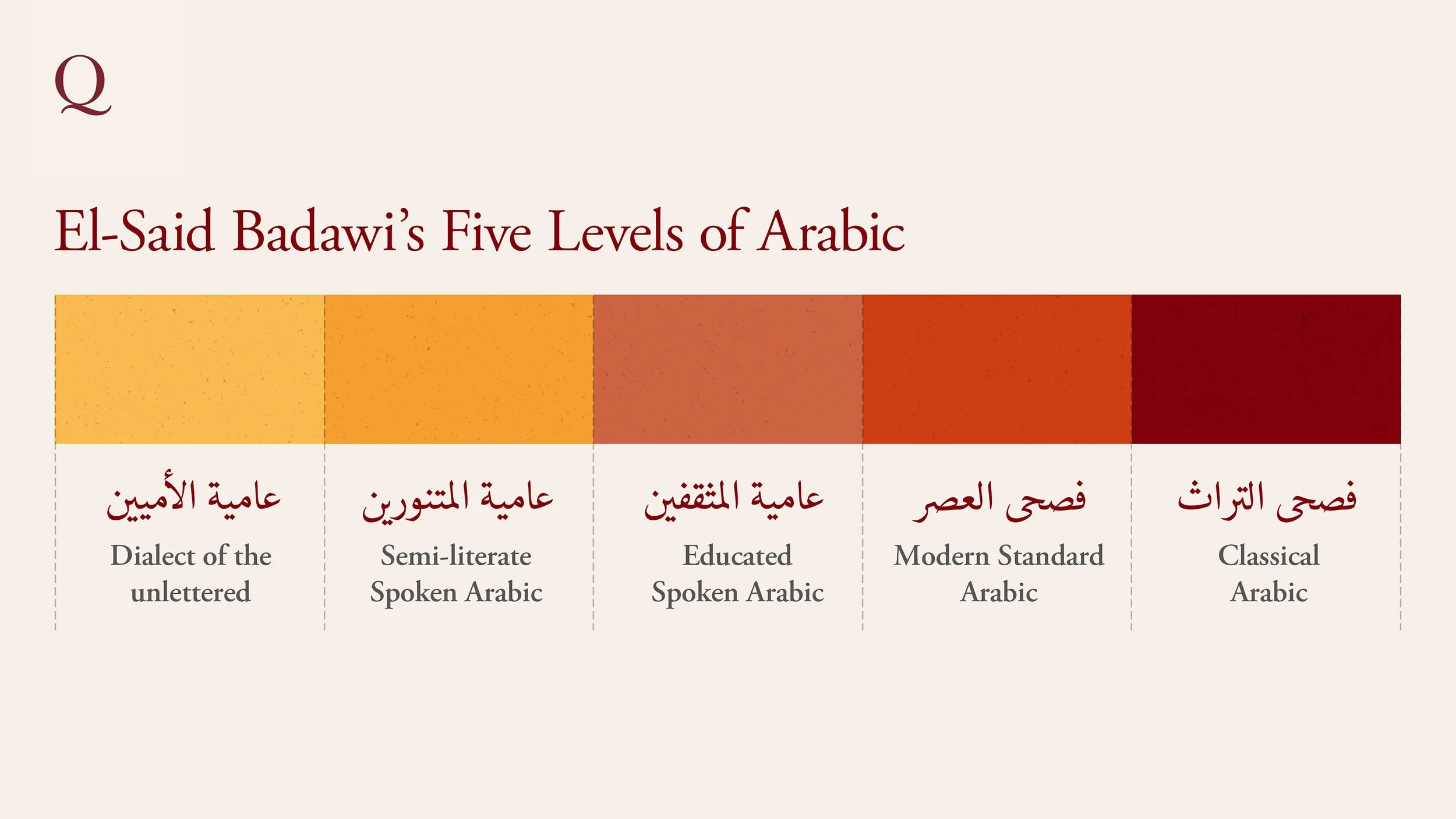
Badawi organized the spectrum into five levels:
(1) fusha al-turath, the classical or heritage register;
(2) fusha al-ʿasr, contemporary Modern Standard Arabic;
(3) ʿammiyyat al-muthaqqafin, the colloquial speech of the highly educated;
(4) ʿammiyyat al-mutanawwirin, the everyday speech of those with some schooling but not advanced education; and
(5) ʿammiyyat al-ummiyyin, the speech of the unlettered.
In practice, we spend nearly all our time on the first three. The bottom two mattered enormously in the Egypt Badawi was describing in the 1970s, when a significant share of the population had little or no formal education; they matter less as literal categories today, now that literacy across much of the Arabic-speaking world is dramatically higher. We still find them useful in a looser sense, as a way of thinking about how speech shifts across generations or levels of schooling, rather than as a precise map of any single country's population today. We raise that limitation on purpose as frameworks like Badawi's are teaching tools, and not timeless laws of nature.
Before defining these registers in more detail, it's worth being honest about a problem that never fully disappears. Whenever you draw the line between one register or dialect and the next, someone will have a reasonable objection. Publish something about Egyptian Arabic being widely understood across the region, and someone will point out, rightly so, that we're really describing Cairene Arabic, and that Alexandria or Upper Egypt tells a different story. Publish something about Gulf Arabic, and whether Yemen belongs in that category alone is enough to divide the comments in two. A specialist can always argue that a given line sits in the wrong place, and may even be right. What no one can reasonably argue is that no line should exist at all. Tell a beginning student that Hassaniyya is spoken in Mauritania, or that a highly specific variety exists in a corner of northern Algeria, and you've shared a true and interesting fact with no bearing on what that student actually needs to study next. Somewhere between infinite respect for every local variety and one flattened idea of "Arabic," a workable framework has to exist. Not because every alternative is wrong, but because a learner starting out needs somewhere to actually stand.
-
Classical grammarians locate Classical Arabic within what they call the ʿasr al-ihtijaj, the "era of authoritative evidence," usually described as roughly three hundred years: about a century and a half before the Hijrah, the Prophet's migration from Mecca to Medina صلى الله عليه وسلم, and a century and a half after it. Reach back further, the reasoning goes, and the historical record grows too thin to trust. Push forward past that window, and the language is already being reshaped by rapid imperial expansion and heavy contact with non-Arabic-speaking populations.
There's a useful parallel in the Oxford English Dictionary, whose first edition took more than seventy years to complete, built on thousands of volunteer readers who combed English literature for evidence of how words were actually used. Classical Arabic scholars did something structurally similar for their own period and region, roughly the Arabian Peninsula from Yemen in the south up toward Iraq in the north, drawing on poetry, letters, and inscriptions as evidence. If you study Classical Arabic today, in a real sense you are still in conversation with that specific historical and geographic frame.
-
Modern Standard Arabic (MSA) has its own separate, comparatively recent origin story, usually traced to the years surrounding Napoleon's arrival in Egypt at the very end of the eighteenth century as it opened a rapid exchange of new concepts, institutions, and political vocabulary that Arabic had to find a way to carry.
The nineteenth-century growth of Arabic-language printing gave that exchange a vehicle. Presses were already active in Lebanon in the seventeenth century and Syria in the eighteenth, and the press expanded rapidly in Egypt from 1809 under Muhammad Ali, culminating in the landmark Bulaq Press, established in 1821. Newspapers and journals like al-Waqaʾiʿ al-Misriyyah, al-Ahram and al-Muqattam turned that expanded vocabulary into something more read widely, rather than confined to scholars and scribes. This is the Nahdah, the Arab renaissance, centered initially in Cairo, reaching Beirut and Damascus and beyond, unfolding alongside the end of the Ottoman Empire and the rise of Arab nationalism. Modern Standard Arabic is the language that emerged from that convergence as a genuinely modern register shaped by modern institutions and a modern reading public. Language academies founded in the decades since continue that project today, coining new vocabulary as the world keeps handing Arabic new things to describe.
-
Between formal fusha and everyday dialect sits a register some scholars call Educated Spoken Arabic (ESA), the blend educated speakers naturally produce in semi-formal settings, without much conscious thought.
The clearest place to watch it happen is broadcast interviews. A news anchor stays close to Modern Standard Arabic almost without exception. The guest, by contrast, typically drifts back and forth between more formal Arabic and dialect over a single answer, sliding toward MSA when the subject turns technical, back toward dialect when it turns personal or emotionally charged. The switching is rarely a conscious decision; it happens the way any of us modulate our own native language without noticing, shaped by topic, audience, formality, and how closely we're monitoring our own speech.
Where exactly Modern Standard Arabic ends and this educated middle ground begins is not a question with a stable answer, and it doesn't need one. What matters is recognizing that the phenomenon is real, patterned, and completely ordinary.
The Boundaries Are Permeable
We've just drawn several clean lines, and now we want to blur them slightly on purpose.
The honest picture of Classical Arabic, Modern Standard Arabic, and dialect looks less like three sealed rooms and more like trees planted next to one another: distinct enough at the trunk, but overlapping well before you reach the canopy. Consider something as small as the word for "yesterday." Depending on where you are and who you're speaking with, you might hear imbarih, al-bariha, ams, or imis, words drawn from different registers and histories, and none of them simply incorrect. Multiply that across every layer of vocabulary and idiom, and the overlap running beneath our tidy teaching categories becomes hard to miss.
We find students often start describing themselves as fixed registers. "I'm a dialect person." "I don't really do Classical Arabic." "MSA isn't really my thing." The instinct makes sense; specialization feels efficient. But taken too far, it hardens into a box that has less to do with the actual shape of the language than it seems to. Ask most Arabic speakers what kind of Arabic they speak, and you'll get a simple fusha/ʿammiyyah answer, not a chart of dialects and registers. The map, it turns out, is not quite the territory, even for the people who live there.
Your Learning Goal Is the Map

The single most useful exercise we recommend to every incoming student at Qasid before choosing the class or selecting a text is to sit down with a notebook and write their destination statement. Complete the sentence “Within the next two or three years, I want to use Arabic to…” as concretely as you can. "Become fluent" is too vague to act on. "Conduct a thirty-minute interview in Jordanian Arabic without switching to English," "read an unvowelled page of classical prose with informed use of a dictionary," or "follow a full Arabic news broadcast and summarize its argument" can genuinely guide you to a decision. Who do you picture speaking with? What will you be discussing? What does the room look like? Is it a lecture hall, an embassy, a hospital corridor, a family gathering in Amman, a manuscript archive, or a boardroom? This is reverse-engineering in the truest sense: start from the destination, and let it define the steps that come before it.
Concretely, that tends to break down along a few lines.
-
If your long-term aim is sustained engagement with tafsir, hadith, law, theology, or the broader premodern tradition, begin by building competence across all four language skills while orienting steadily toward Classical Arabic. As you progress, morphology, syntax, sustained reading, and close contextual analysis become more important, alongside the disciplinary knowledge those texts presuppose. "Classical Arabic" is not a complete plan on its own: legal theory, poetry, and biographical writing each require their own vocabulary and conventions. Modern Standard Arabic can support contemporary scholarship, while spoken Arabic keeps the language active and communicative. The long-term center may be classical, but the path toward it should remain broad.
-
Spanning anything from history and anthropology to politics and religious studies, your priorities should be guided by your actual research question rather than by a generic hierarchy of academic prestige. A historian of the Abbasid period and an anthropologist studying labor in contemporary Jordan are both doing serious scholarship, but one may need years of close textual reading while the other needs rapidly spoken dialect and social nuance from day one.
-
In diplomacy, development, journalism, healthcare, law, or education, competence is usually less about mastering a single ideal register than about knowing which register the moment calls for. Formal Arabic often conveys precision and institutional authority; dialect often creates immediacy, trust, and warmth. If you already know where you will be working, the relevant dialect deserves early attention.
-
Dialect has to carry substantial weight, because daily life unfolds through requests, jokes, invitations, and the small courtesies of everyday interaction, whose meaning depends as much on tone and relationship as on vocabulary. Modern Standard Arabic matters too, appearing in signs, forms, news, and official communication, but it cannot, by itself, give you the language of the home, the street, or the neighborhood.
-
If you are reconnecting with the speech of parents or grandparents, or with a community from which you have felt partly separated, dialect will usually deserve priority. You belong to what language teachers call heritage learners, or heritage speakers, and your plan should begin from the Arabic you already have, not from where a standard beginner starts. Uneven strengths are entirely normal here: you may excel in listening but have limited literacy, or carry rich household vocabulary alongside a formal grammar that never quite developed. Modern Standard Arabic can then add literacy, range, and wider access, without displacing the reason you began. Heritage learners deserve a fuller treatment than a paragraph allows. We'll return to them in a separate article.
None of these paths is more legitimate than the others, and none comes free. What changes is which register earns your limited hours first. And because goals genuinely change (a student of theology may end up needing dialect after years in the region; a journalist may fall in love with classical poetry), this is worth revisiting at the end of every course, quarter, or major stretch of immersion. A good map tells you more than where you are going. It tells you what to prioritize today, and what to redraw when the terrain changes.
Fluency Is Range, Not Purity
Fluency, properly understood, is not mastery of one register held in isolation. It is the ability to move across the spectrum with increasing ease, shifting according to who you are speaking with, what you are discussing, and where you are. You already do this in your own language without noticing. You do not speak to a child as you would in a job interview, or write a research paper as you would text a friend. Vocabulary changes, syntax changes, tone changes, and something in how you present yourself changes with them. Arabic asks for the same responsiveness. The distance between some of its registers simply makes that responsiveness harder to miss. A fluent speaker senses what a setting permits, recognizes a classical phrase surfacing inside contemporary speech, follows an argument carried in Modern Standard Arabic, and catches the dialectal aside that reveals what someone actually feels. No one commands every register or period of the language equally, and none of this asks them to. Range is not totality.

This is why the familiar question, MSA or dialect, works better as a question of sequence than of identity. As a sequence, it's simple: Which one should I focus on first, given what I actually want to do with the language? As identity, "I'm a dialect person," "MSA is artificial," it stops being useful. It starts to sound like a reason not to learn the rest of Arabic.
Part of fluency is knowing not only what a phrase means, but also where it belongs. What lands naturally in one setting may sound awkward, overly formal, or simply misplaced in another, and sensing that difference is itself part of range. Fluency, then, is not purity of register. It is the ability to speak appropriately within a situation, reaching for what the moment calls for, and reaching for it correctly. Depth gives you command of the language. Range allows that command to travel.
Have a Center of Gravity
Recognizing Arabic as a spectrum invites a new mistake. A learner hears that Classical Arabic, Modern Standard Arabic, educated speech, and dialect all matter, and decides to study everything at once. The impulse feels open minded, yet no one can actually move across the whole spectrum simultaneously. Whether by personal choice or by the structure of an intensive program, every learner eventually enters one channel and builds real depth there before doing much else with the rest. Trying to advance in Classical Arabic, Modern Standard Arabic, and two regional dialects at the same time is not ambition. It is usually a quiet way of ensuring slow progress in all four.
At Qasid, we often think in terms of a vertical trajectory accompanied by horizontal awareness. In the earliest stages, Levels One and Two broadly speaking, we want students rising steadily and narrowly within one track, without constantly glancing sideways at every other register available to them. That focus is not a limitation on a student's future range. It is what makes real range possible later. By the end of Level Two, and increasingly through Level Three and beyond, a different kind of engagement becomes genuinely valuable. Students begin noticing where their track touches the others, and comparison starts to sharpen what has already been built rather than confuse what is still under construction.
The puzzle helps explain why. In the beginning a learner simply connects whatever pieces fit, a rule here, a word there, without much sense yet of the larger picture. Once a real, connected section has taken shape, however small, it becomes possible to step back and notice how the whole picture is meant to fit together. Before that point, glancing toward every other corner is distraction. After it, glancing around is how genuine range gets built. Depth in one area tends to serve the whole in this way. Morphological grounding built through Classical Arabic or Modern Standard Arabic often clarifies patterns that surface later in dialect, and sustained listening in a dialect sharpens a student's pronunciation, rhythm, and feel for idiom in turn. The aim, in the end, is a center of gravity rather than a prison.
Flexibility Is Earned
There's a practical question hiding inside everything said so far about range. How does a learner actually acquire it?
A younger person may be able to perform certain movements immediately, with little or no preparation, simply because the body is still naturally flexible and adaptable. An older person trying the same movements without preparation could easily strain or injure themselves. With age, the body often needs a more gradual approach, building strength, flexibility and mobility over time before attempting anything especially demanding.
Language works in a remarkably similar way. Genuine flexibility across Arabic's registers is not something a learner can simply reach out and grab at the start. It has to be earned through a long accumulation of narrower, more disciplined steps. Solid grammar. Real vocabulary. Consistent exposure. One track at a time. A student who tries to be maximally open and flexible from day one, sampling every register before building real strength in any of them, tends to injure their own progress in ways harder to notice than a torn muscle, but no less real. Flexibility is an emergent quality. It shows up as the result of disciplined, structured work, not as a shortcut around it.
That's worth remembering the next time range starts to sound like an excuse to avoid depth. Range is what depth eventually becomes, not a substitute for it.
Choosing a Direction

Return, for a moment, to Seneca's sailor. The point was never that effort doesn't matter. Stoic philosophy has never been shy about the value of discipline. The point is that discipline needs a destination before it can do anything useful. The same wind that wastes a directionless sailor's time will carry a purposeful one exactly where they meant to go.
Our task at Qasid has never really been just to teach Arabic content, the vocabulary lists, the verb tables, the reading passages. It's to help each student find their own port before we ever ask them to start rowing, and to hand them an honest picture of the water they're about to sail into. That's what an orientation is supposed to do, in both senses of the word. It gives you your bearings. It points you somewhere real.
Al-Khalil's posture, offered from inside a house he didn't build, still holds up. Walk through the structure of this language with real attention. Take your best guess at why it's shaped the way it is. Hold that guess loosely enough to let a better one replace it later. Once you've looked around enough to have some sense of where you stand, and once your own destination is written down in your own words, choose a direction, and go.
What the daily work looks like once you've chosen a track is a question our Arabic Study Skills Guide takes up in detail, and it's a good place to go next. Fluency, too, is relative to your destination. A fluent reader of a ninth-century text and a fluent conversationalist in a modern living room aren't measured by the same yardstick at all.
For now, it's enough to know the shape of the water and to know your own port. The wind will be there either way. The port is yours to name.
This guide draws on a series of lectures developed at Qasid Arabic Institute and presented by its Director, Omar Matadar. The insights it contains, refined through years of teaching and advising serious Arabic learners, form the intellectual foundation of much of what is written here. We consider it a living document, one that will continue to grow as our understanding deepens.
References
Ayalon, A. (2016). The Arabic Print Revolution: Cultural Production and Mass Readership. Cambridge University Press.
Badawi, E. S. (1973). Mustawayat al-'Arabiyyah al-Mu'asirah fi Misr: Bahth fi 'Alaqat al-Lughah bi-l-Hadarah. Dar al-Ma'arif.
Ferguson, C. A. (1959). Diglossia. Word, 15(2), 325-340.
Fishman, J. A. (1967). Bilingualism with and without diglossia; diglossia with and without bilingualism. Journal of Social Issues, 23(2), 29-38.
Oxford English Dictionary. A Historical Record of Creativity in Language.
Seneca. Epistulae Morales ad Lucilium, Letter 71.3.
Versteegh, K. (1995). The Explanation of Linguistic Causes: Az-Zajjaji's Theory of Grammar. John Benjamins.
Versteegh, K. (1997). The emergence of Modern Standard Arabic. In The Arabic Language. Edinburgh University Press.
al-Zajjaji, A. Q. Kitab al-Idah fi 'Ilal al-Nahw, Chapter 5 (al-bab al-khamis).