Returning with Hunayn's Slippers: The Arabic Proverb رَجَعَ بِخُفَّيْ حُنَيْن and the Story Behind It
A man comes home from a long journey. His people gather to meet him and ask the obvious question: “What did you bring back?” His answer is cryptic: “Hunayn's two slippers.”
To his family, and to us more than a thousand years later, those words make sense only once the story unlocks their meaning. And the story turned out to be so iconic that the sentence outlived everyone in it, hardened into a proverb, and is still in a native speaker's mouth today. This is that story, and this is what it can teach a serious student of Arabic: about loss, language, and why the oldest sayings are often the ones most worth learning.
What رَجَعَ بِخُفَّيْ حُنَيْن Means
The proverb is رَجَعَ بِخُفَّيْ حُنَيْنٍ (rajaʿa bi-khuffay Hunayn). Translated word for word, it says he came back with the two leather slippers of Hunayn. As an idiom, it means he returned having gained nothing and came back empty-handed.
Most translations stop there, but the man in the story did not come home with empty hands. He came home holding something. The true meaning of the proverb lives in the distance between holding something and gaining nothing, and that distance is where its bite comes from. Hold the question in mind as you read: what is the difference between returning with nothing and returning with something worthless? By the end, the proverb will have answered it for you.
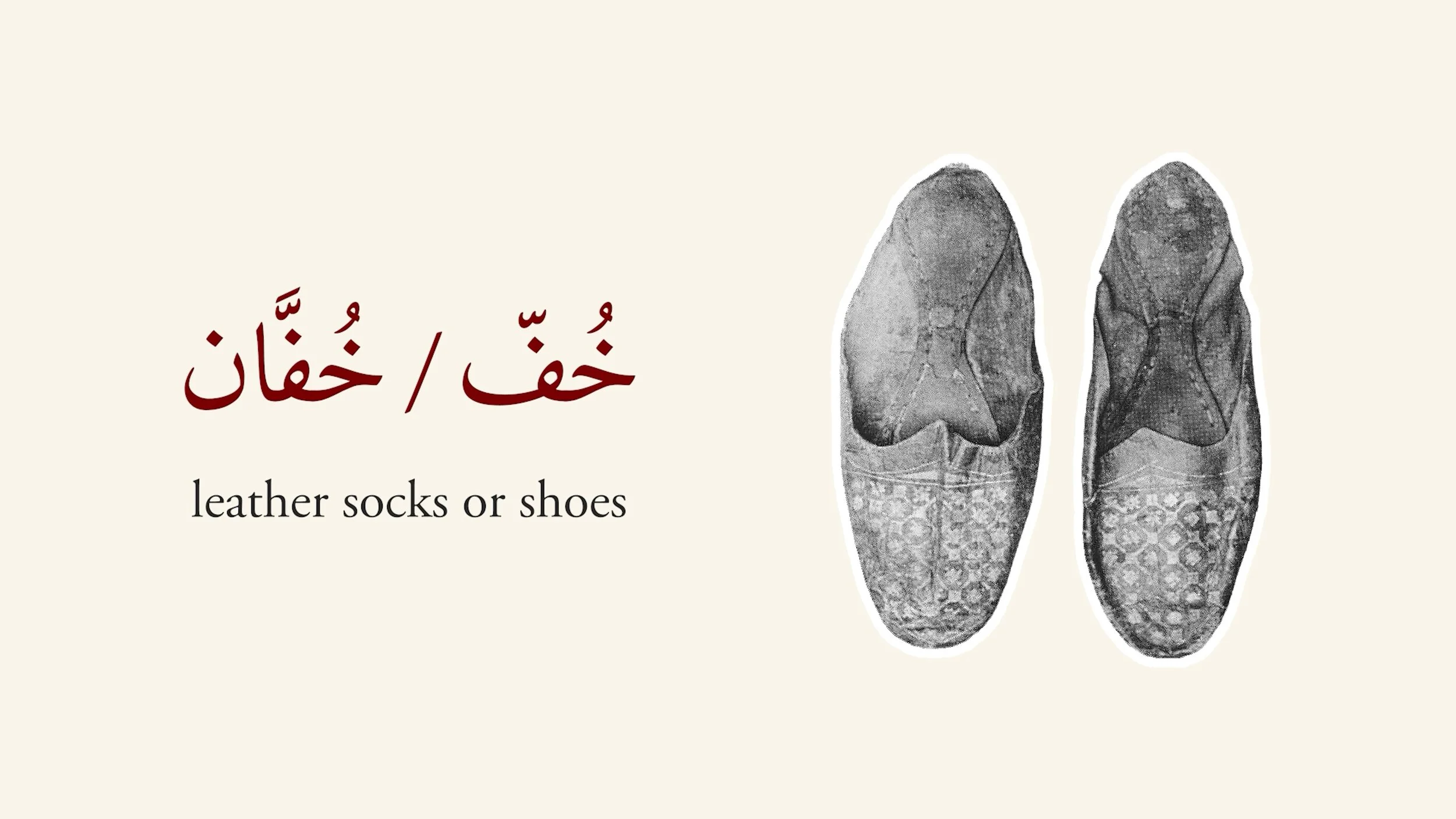
One word needs a note before we go on. A خُفّ (khuff) is not quite a slipper and not quite a sandal. It is a soft leather footwear, closer to a leather sock or a light leather boot. Students of Islamic law may recognize this type of footwear from the rulings on wuḍūʾ, the ritual ablution Muslims perform before prayer. Picture something modest and ordinary. The smallness of the object is part of the point of the story.
The Story of Hunayn the Shoemaker

The setting is al-Hira, a prosperous town in southern Iraq and one of the cultural centers of the pre-Islamic Arab world. A man named Hunayn lived there and worked as an iskaf, a shoemaker, the practitioner of a craft that has all but vanished from modern life.
One day a Bedouin came in from outside the town to buy a pair of leather slippers, and what should have been a simple sale became an ordeal. The Bedouin haggled. Then he haggled more. He pressed and pressed over the price of a pair of ordinary slippers until the shoemaker's patience wore through completely. No sale was made. The Bedouin left.
But Hunayn was not finished with him.
He knew which road the Bedouin would take out of town. He took one of the two slippers the man had been haggling over and set it down in the road, as if it had been dropped there by accident. Then he walked further along the same road and left the second slipper. And then he waited.
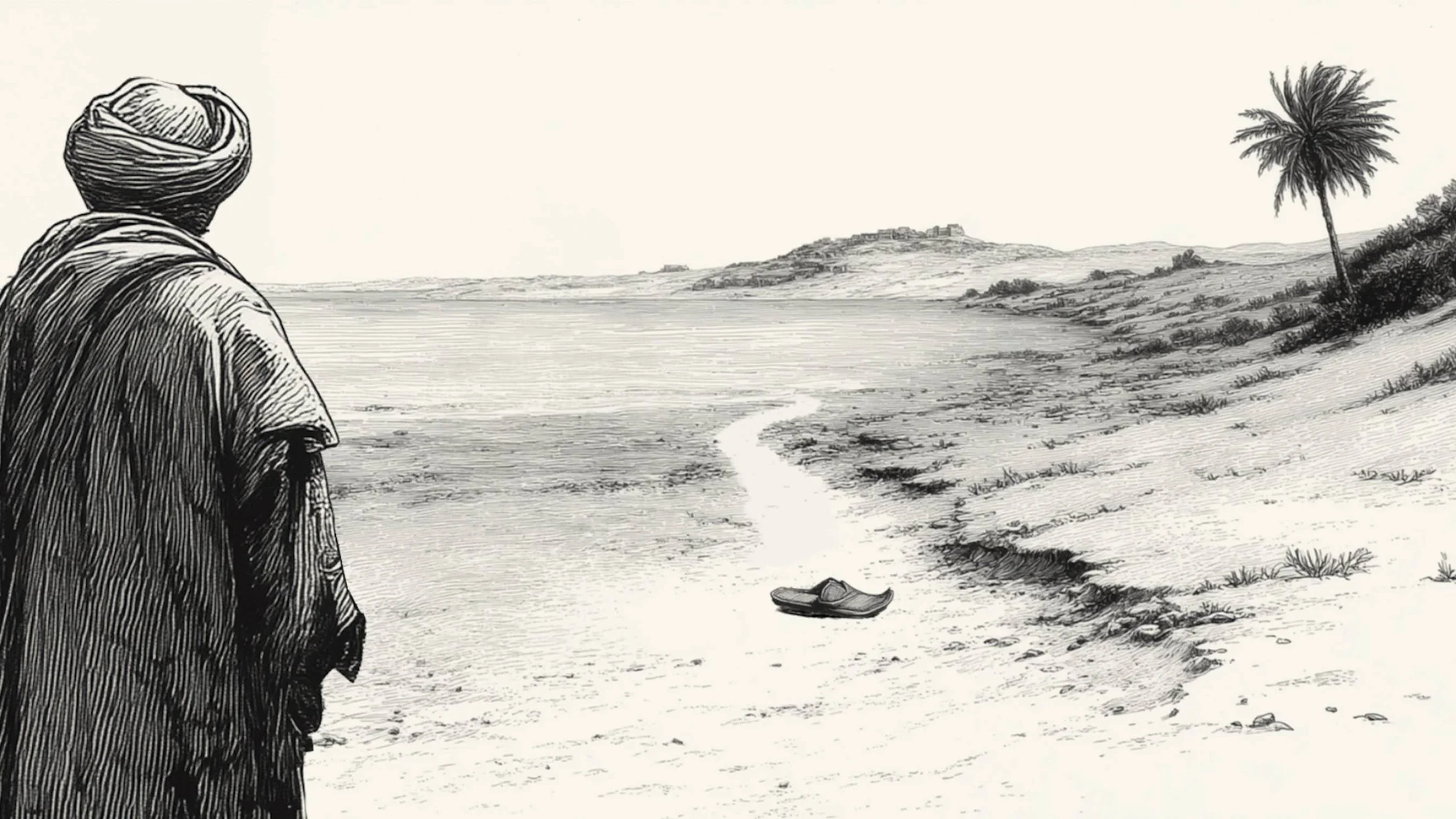
The Bedouin came upon the first slipper, recognized the workmanship as Hunayn's, and looked at it with a flicker of regret. Fine craftsmanship but a single slipper is no use to anyone. So he left it where it lay and walked on.
A little further down the road, he found the second.
Now the calculation changed. With both slippers within reach, the one he had abandoned was suddenly worth retrieving, because together they made a usable pair. So the Bedouin turned around and walked back to collect the first slipper.
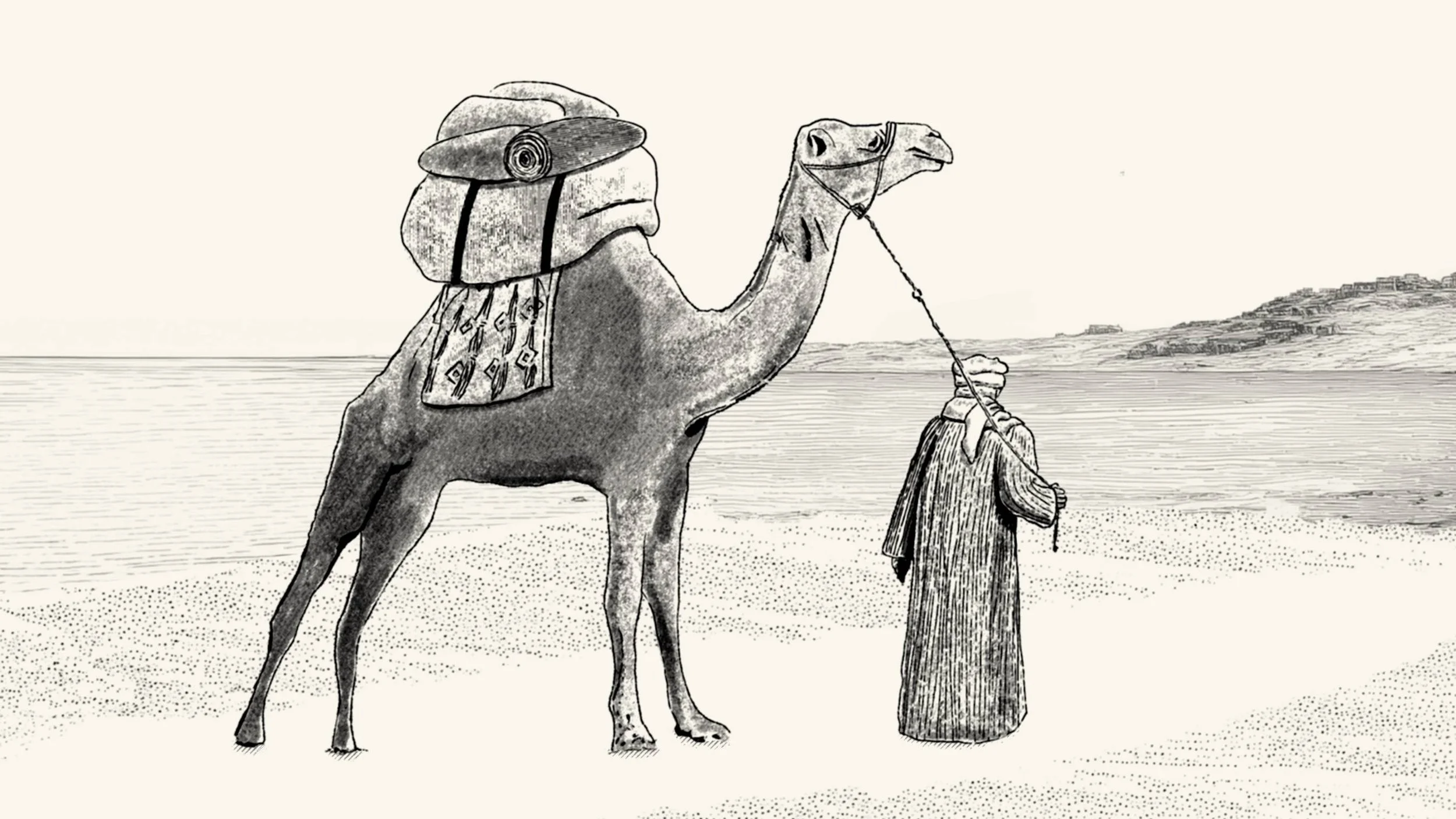
That was the whole purpose of the plan. While the Bedouin retraced his steps, Hunayn went straight to the man's camel, waiting on the road with everything the Bedouin owned loaded onto its back, and led it away, cargo and all.
When the Bedouin returned at last, both slippers finally in hand, there was no camel. There was no shoemaker. There was nothing on that road but a man and a matched pair of leather slippers.
He went home. His people asked what he had brought back from his journey. And he gave the answer that became the iconic proverb: جئتكم بخُفَّيْ حُنَيْنٍ - "I have come back to you with Hunayn's two slippers."
Why the Proverb Says More than “Empty-handed”
Now return to the translation. “Empty-handed” describes a man with nothing in his hands, and the Bedouin's hands were not empty. He was holding the very slippers he had set out to buy. In the narrowest, most literal sense, he succeeded in what he wanted: he went looking for Hunayn's slippers, and came home with Hunayn's slippers.
But that is the cruelty of it. The slippers are not a consolation; they are a reminder. They are the exact measure of what his own miscalculation cost him. For the rest of his life, every time he looks at them he will see the camel, the cargo, and the moment on the road when he decided that turning back was worth it.
رَجَعَ بِخُفَّيْ حُنَيْن is not a proverb about ordinary loss. It is a proverb about a particular and bitter kind of loss, the kind where the small thing you walk away with serves only to underline the larger thing you walked away from. English has no single phrase for that idea. Arabic put a whole story behind four words and considered the matter settled.
Underneath the wit there is a shrewd reading of human nature. Hunayn's trap worked because he understood a weakness almost everyone shares: we routinely undervalue what is in front of us until some later event reprices it, and then, in the rush to recover what we wrongly dismissed, we leave something far more valuable unguarded. The Bedouin was undone by greed and the urge to correct a small mistake one moment too late. Arabic proverbs often reveal their power not through grand moral failure, but through the precise mechanics of an everyday misstep.
Arabic Words Worth Knowing
For serious Arabic learners, a proverb like this one is far more than a clever phrase to memorize. The story behind it is a small treasury of vocabulary, and several of its words teach much more than themselves. Three are worth unpacking.

-
Begin with Hunayn's profession. He was an إِسْكَاف (iskaf), a shoemaker, a word many students never encounter, because the trade itself has mostly disappeared into factories. The craft of shoemaking is سِكَافَة (sikafa), and that word is more valuable than it first appears, because it sits on one of Arabic's most dependable patterns for naming crafts and professions: فِعَالَة (fiʿala). Once that pattern is in your ear, a whole field of vocabulary organizes itself around it. زِرَاعَة is farming, نِجَارَة is carpentry, صِنَاعَة is manufacturing or industry. Learn سِكَافَة as an isolated word and you have gained one vocabulary item. Learn it as an instance of فِعَالَة and you have gained a key that opens many doors.
-
One of the most rewarding words in the story is the one the classical sources choose for what Hunayn wanted the Bedouin to feel. It is not the everyday word for anger, غَضَب (ghadab). It is غَيْظ (ghayz).
The two are not interchangeable. Classical lexicographers describe غَيْظ as al-ghadab al-muhit bi-l-kabid - the anger that surrounds the liver. The image draws on an older understanding of the body in which the liver was treated as a seat of certain deep, burning emotions. غَضَب can be a sudden flash. غَيْظ is a fire that takes hold of the whole person.
There is a second distinction, and it is the one that makes غَيْظ the perfect word for this particular story. The scholars observe that غَيْظ carries with it a sense of عَجْز (ʿajz) - incapacity. It is the anger of someone who is furious and can do nothing about it: anger with no outlet, heat that turns inward because it has nowhere else to go. Hunayn did not merely want to irritate the Bedouin. He wanted him to feel a fury he could not act on. To stand on an empty road, holding two useless slippers, and burn. The single word غَيْظ contains that entire intention.
-
Three verbs in the story quietly correct assumptions that beginning students often carry with them.
The first is مَضَى (mada). Many learners know it only through the grammatical term الماضي, "the past tense," and so they assume the verb is somehow about pastness. مَضَى here means to go on, to proceed, to continue along one's way, which is precisely what the Bedouin does when he leaves the first slipper behind and keeps walking.
The second is انْتَهَى (intaha). Students usually meet this verb through the idea of ending; it is the close relative of نِهَايَة, an end. That makes the phrase انْتَهَى إِلَى look as though it should mean "to finish." In fact انْتَهَى إِلَى means to arrive at, to come to, to end up at a place. The Bedouin intahā ilā the second slipper means he came upon it.
The third is the small, easily overlooked ذَهَبَ بِـ (dhahaba bi-). On its own, ذَهَبَ simply means "to go." Attach the preposition بِـ, and the meaning shifts decisively: ذَهَبَ بِالشَّيْءِ means to go off with something, to carry it away. When the classical sources say that Hunayn dhahaba bi رَاحِلَة (rahila), the Bedouin's riding camel, they are not saying he walked over to it. They are saying he made off with it. One preposition carries the entire theft.
This is the quiet argument for learning Arabic through its stories and not only through its wordlists. A list would hand you مَضَى glossed flatly as "to pass." The story hands you مَضَى as a man walking away from a slipper he is about to wish, badly, that he had kept. That is a meaning you do not forget.
A Proverb to Quote, Not to Conjugate
Here is a point that catches many learners by surprise. If you yourself came home from a wasted journey, instinct would tell you to say رَجَعْتُ بِخُفَّيْ حُنَيْن - "I came back with Hunayn's slippers" - putting the verb in the first person to match yourself as the speaker. It feels like the grammatically tidy thing to do.
The classical scholars say otherwise. A proverb, in the stricter traditional view, is quoted in the exact form in which it was handed down. رَجَعَ بِخُفَّيْ حُنَيْنٍ is third-person masculine singular, and it remains third-person masculine singular, whether the speaker is a woman, whether the subject is a group, whether it is you. The proverb is treated less like a sentence you build and more like a quotation you cite. It is a fixed object, pointed to rather than reshaped.
In ordinary speech, native speakers are not always so disciplined, and you will certainly hear proverbs bent to fit the sentences around them. But the traditional handling is worth knowing, that proverbs are quoted and not conjugated.
The Necessary Half-Truths of Learning Arabic
It is worth noting here how Arabic is taught traditionally and where Qasid's approach occasionally departs from it. Specifically, in our willingness to favor grammatical opinions that are less common or less widely known within the broader scholarly tradition. The Arabic linguistic tradition, classical and modern alike, is genuinely vast; almost every rule travels with a retinue of exceptions and competing scholarly opinions. Presenting all of it to a beginner learner at once is neither practical nor kind. Sound teaching simplifies first and complicates later, in that order. We sometimes tell our students, half in jest, that learning Arabic is a series of half-truths. Each stage offers a picture complete enough to stand on, with the next stage filling in what the last one set aside for the time being.
This proverb is a friendly example of the principle at work. Students who have previously studied Arabic may notice in the video two points in our treatment of it that differ from what they have encountered elsewhere: first, our rendering of the conjunction ثم, and second, our description of تاء التأنيث الساكنة as an attached pronoun. Both choices are deliberate; both represent positions that, while not universally adopted, are well attested and serve the learner well at this stage.
Using رَجَعَ بِخُفَّيْ حُنَيْن Today
This proverb remains in active use, in formal Arabic and in everyday dialect alike, and it surfaces in exactly the situations where an English speaker would say that someone "came back with nothing to show for it."
Picture a team that spends weeks preparing a proposal, travels a long way to present it to a client, does everything that is asked of them, and returns without the contract. That is رَجَعَ بِخُفَّيْ حُنَيْن. Or picture someone who spends an entire day going from shop to shop in search of one particular item and comes home having found nothing. That, too, is رَجَعَ بِخُفَّيْ حُنَيْن.
What the proverb adds, and what a plain statement of failure cannot, is tone. It does not merely report that an effort failed. It frames the failure, the labor poured into it, the irony of the result, the faint absurdity of so much effort yielding so little. To reach for this proverb is to say not just "it did not work" but "it did not work, and there is something almost comic in how little I have to show for it." That economy, a full attitude delivered in four words, is what a living proverb does, and it is what makes this one worth carrying in your own Arabic.
Why Proverbs Reward the Serious Learner
It is tempting to treat proverbs as decoration: a flourish to add once the "real" grammar and vocabulary are securely in place. That is a mistake.
A single proverb can train the serious learner in several directions at once. From this one story, you have met concrete vocabulary - إِسْكَاف, خُفّ, رَاحِلَة, غَيْظ - and a productive pattern, فِعَالَة, that appears across Arabic. You have sharpened verbs whose meanings are often flattened by beginners. You have stepped briefly into al-Hira, a real city of the pre-Islamic Arab world, and seen how Arabic preserves social setting, human motive, and moral consequence in a few compact words.
That is the case for taking proverbs seriously. Grammar and vocabulary build the working machinery of a language. But proverbs are where a language stores its memory and its humor, the point at which Arabic stops being a system you are decoding and becomes a culture you are beginning to inhabit.
Hunayn's victim lost everything because he moved too quickly past what deserved his attention. Arabic rewards the opposite instinct. Slow down. Weigh the words. Notice what the story is quietly showing you. A proverb will then give you far more than its translation.
Frequently asked questions
-
رَجَعَ بِخُفَّيْ حُنَيْن (rajaʿa bi-khuffay Hunayn) literally means "he came back with Hunayn's two leather slippers." As an idiom it means to return having gained nothing, to come back empty-handed. Its particular force is that the person returns holding something essentially worthless, which only highlights the far greater loss they suffered along the way.
-
Hunayn was a shoemaker from al-Hira, a town in pre-Islamic Iraq. According to the traditional account, a Bedouin haggled with him relentlessly over a pair of leather slippers, irritating him so badly that Hunayn devised a scheme to take revenge that ended with him making off with the Bedouin's camel and all his belongings.
-
The proverb comes from a classical story in which Hunayn the shoemaker, angered by a customer's endless bargaining, planted the two slippers along the road the customer would travel. When the Bedouin doubled back to retrieve the first slipper, Hunayn stole his unguarded camel and cargo. The Bedouin returned home with only the slippers, and his words describing it - "I have come back to you with Hunayn's two slippers" - passed into Arabic as a proverb.
-
Yes. Although it is a classical proverb, it remains in common use today in both Modern Standard Arabic and regional dialects. It is applied to any situation where someone invests significant effort into a venture, a business deal, a negotiation, a search, and comes away with nothing worthwhile.
-
A خُفّ (khuff) is a piece of soft leather footwear, closer to a leather sock or a light leather boot than to a modern slipper or sandal. It is the same footwear referred to in Islamic legal discussions of wiping over the khuffs during ablution.