

Levantine Dialect (Ammiya)
The Levantine Dialect Program is designed to equip students with the language of daily life, enabling them to communicate naturally and integrate seamlessly into Arab societies. Learning Ammiya is an essential step toward achieving native-like fluency, complementing formal study of Arabic. Courses are offered in Jordanian, Syrian, and Palestinian dialects.
Why Levantine Dialect Builds Spoken Fluency
Even the most advanced students of Arabic quickly realize during their first taxi ride or market visit in Amman that locals rarely speak in Fusha. Instead, Levantine Arabic is the language of everyday connection, shaping everything from greetings and jokes to negotiation and nuance. A grounding in the Levantine dialect is therefore essential for maximizing daily interactions—whether living, studying, or working in the region.

Curriculum Levels
-
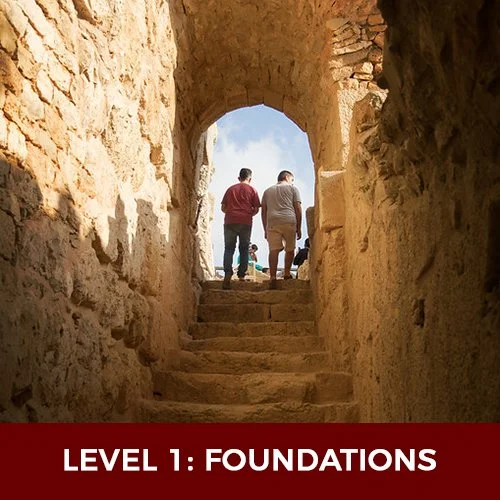
Level 1: Foundations
Overview: The Beginner Levantine Dialect Program builds confidence in everyday communication through speaking practice, role-play, and dialogue. Students are introduced to commonly used vocabulary, expressions, and structures in Jordanian Ammiya, while gaining practical fluency in daily-life situations such as shopping, navigating the city, greetings, and small talk.
Courses: AMM 101 – Master the basics of conversation: asking and answering simple questions, understanding everyday expressions, and distinguishing when to use Ammiya instead of Fusha. Students reach approximately Beginner A (ACTFL). AMM 102 – Strengthen conversational ability with greater fluency and accuracy in daily exchanges, expanding exposure to media (billboards, radio, cartoons). Students progress toward Intermediate B (ACTFL). AMM 103 – Consolidates and extends Beginner-level skills, focusing on smoother, more confident conversation and comprehension of common spoken and written Ammiya. Students complete the Beginner track at Intermediate B (ACTFL).
Duration: Three sequential courses, each 10 weeks in length, with one live private 1-on-1 session (50 minutes) per week.
Prerequisites: Familiarity with the Arabic alphabet, plus basic grammar and vocabulary.
Tuition: $495 per course.
-
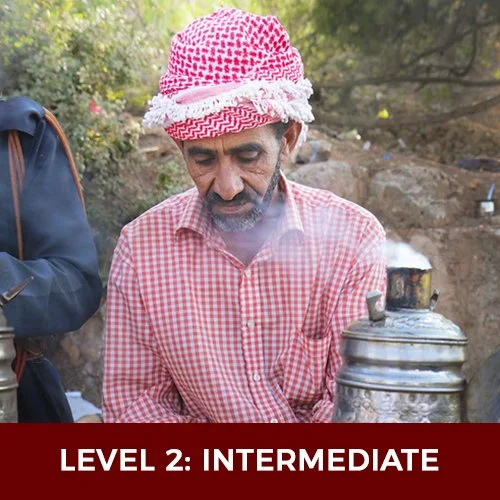
Level 2: Intermediate
Overview: At this stage, students can follow simple conversations and use a limited range of colloquial expressions, though Fusha still outweighs Ammiya in their speech. This level emphasizes listening and conversation—the most essential skills for living and working in Jordan—while also building vocabulary and expressions for daily-life contexts such as shopping, ordering food, describing people, household routines, cultural occasions, and handling common real-life situations.
Courses: AMM 201 – Develop confidence in everyday dialogue, handling familiar life situations with basic colloquial expressions. Students begin incorporating idioms and proverbs appropriately. AMM 202 – Strengthen conversational fluency, expand descriptive ability, and handle exchanges requiring more detail. AMM 203 – Consolidates skills for sustained dialogue, enabling students to enter public conversations with confidence and greater independence.
Duration: Three sequential courses, each 10 weeks in length, with one live private 1-on-1 session (50 minutes) per week.
Prerequisites: Completion of Level 1 (online or on-site), or placement via exam.
Tuition: $495 per course.
-
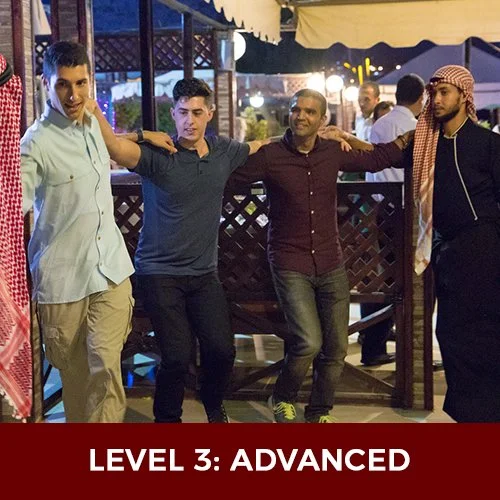
Level 3: Advanced
Overview: At this stage, students have a solid foundation in colloquial grammar and vocabulary and can conduct meaningful dialogues about their environment. The focus remains on listening and conversation, with practice drawn from authentic materials such as TV shows, magazine articles, recipes, and health-related topics.
Courses: AMM 301 – Engage in discussions on community issues, expanding the ability to navigate varied topics in colloquial Arabic. AMM 302 – Develop accuracy in all tenses, tell detailed stories, and sustain extended conversations understood even by native speakers. AMM 303 – Consolidates advanced skills with emphasis on accurate use of idioms and proverbs in their proper contexts, bringing speech closer to native fluency.
Duration: Three sequential courses, each 10 weeks in length, with one live private 1-on-1 session (50 minutes) per week.
Prerequisites: Completion of Level 2 (online or on-site), or placement via exam.
Tuition: $495 per course.
“The weekly one-on-one sessions with my instructor have been essential to my learning. Whenever I feel hesitant about expressing myself or uncertain in my grasp of a concept, these sessions provide clarity and confidence. That dedicated time to practice, with thoughtful guidance, has made all the difference in deepening both my fluency and understanding.”
— Ray L., College Professor
What makes Qasid Online unique?

-
No more adjusting your life around fixed group schedules. With 1-on-1 sessions, your instructor offers multiple time options, and you simply choose what works best. This flexibility makes it far easier to attend every session consistently.
-
In group classes, instructor attention is divided. In private sessions, 100% of the time is devoted to you—maximizing progress and depth of learning.
-
One-on-one learning means your instructor can concentrate on your specific challenges and goals, rather than balancing the needs of many students at once.
-
Private instruction moves at the pace that best suits you. Move quickly when you have momentum, or slow down during busier weeks—your instructor will adjust to keep you moving forward effectively.
How the Programs Work
Qasid Online combines a rigorous, academically designed curriculum of recorded materials (video lessons, texts, and quizzes) with live, private 1-on-1 sessions—bringing together the best of structured content and personalized instruction.

Structured Pathway
Each course runs for 10 weeks and, at a steady pace, covers the equivalent of one university quarter of Arabic. Completing three consecutive courses equates to roughly one full year of university-level Arabic study.

Individual Instruction
Students receive one live, 50-minute, one-on-one class each week with a Qasid instructor—ensuring focused guidance, individualized feedback, and steady progress.

Dedicated Learning Platform
During each 10-week enrollment, students gain full access to Qasid’s custom Learning Management System (LMS), which houses the entire MSA curriculum—hundreds of videos, PDFs, and quizzes designed to reinforce live instruction.

Academic Mentorship
Alongside your instructor, you’ll be paired with an academic mentor who supports your learning journey, helping you navigate challenges and stay on track toward your goals.

Community Support
Beyond your individual classes, you’ll have access to Qasid’s private, student-only community, where you can connect with peers, exchange insights, and ask questions.

Scholarly Recognition
Upon successfully completing each level, you’ll receive an official Qasid Certificate of Completion—digital by default, with a printed copy available upon request to support your academic or professional portfolio.
“Qasid isn’t just another self-study program. In less than a year, I was able to hold a basic conversation in Arabic with my teacher during live sessions. Within just a few months, I could already read and write the language—something that still amazes me. The flexibility of online learning has been incredible: I can spend time with my family, be present as a mother, and still make real progress in Arabic.”
— Amanda F., Level 2 Intermediate Student
Frequently Asked Questions
-
Absolutely. Many of our students begin with no prior knowledge of Arabic. We start by teaching you the alphabet and foundations, and then guide you—step by step—towards fluency.
-
Not at all. We’ve worked with learners of all ages, professions, and family commitments. With our method, age and schedule are no barrier. We’ll show you how to make consistent progress—even if you have a demanding job or children at home.
-
Every student progresses differently, depending on effort, background, and consistency. We won’t make empty promises of “fluency in 3 months.” Instead, we provide a structured curriculum, live support, and lifetime access to resources. If you stay committed, you’ll look back in 1–2 years amazed at how far you’ve come.
-
Qasid Online is the only program built on over a decade of experience teaching 10,000+ students worldwide. Unlike “Arabic-lite” courses, our curriculum mirrors university-level rigor while giving you lifetime access to videos, quizzes, worksheets, and a library of 24/7 resources. And with one-on-one live sessions, your learning is always personal and practical.
-
You’ll work through a structured curriculum of pre-recorded lessons, exercises, and quizzes at your own pace. Once a week, you’ll meet one-on-one with a native instructor to practice speaking, get personalized feedback, and have your questions answered. This blend of self-paced learning and live mentorship keeps you both flexible and accountable.
-
No travel is required. All core materials are available online, on-demand, from anywhere in the world. Your live sessions are scheduled with your instructor at times that work for you, so you can progress without uprooting your life or career.
-
We recommend 5–10 hours per week. The more consistently you invest, the faster your progress. With lifetime access, you can move as quickly—or as slowly—as your schedule allows.
-
Because the program combines self-paced study with flexible live sessions, you’ll never “miss the boat.” You can pause, slow down, or catch up whenever your schedule allows. Our goal is sustainable, long-term growth—not short-term pressure.
-
The MSA program is organized into five levels, with each course lasting 10–20 weeks. Some students complete three or more courses a year, while others take breaks between levels. Your timeline is flexible, designed to fit around your life commitments.
-
Every student—beginner or advanced—takes a placement test. This diagnostic (not pass/fail) allows our academic team to place you at the right level, so you build on your strengths without repeating material unnecessarily.
-
Once you’ve completed payment, you’ll take the placement quiz, book an orientation session, and gain full access to your online platform. You’ll then schedule your one-on-one live sessions and begin your first course.
-
Each course is $495 USD. For example, Level One (Foundations) includes three courses—each at $495. You’re not required to register for all at once, giving you financial and academic flexibility.
-
Yes. Tuition can be split into two monthly installments: one at enrollment, and the second one month later.
-
Qasid Online courses can be taken for a grade and credit, but that credit cannot be applied toward a degree at the moment. It may be possible to apply that credit toward a degree program at another college or university, depending on that institution’s academic policies.
-
Yes. Upon successful completion of a program, you’ll receive a certificate of completion from Qasid Online. Students may also request an official transcript for their coursework.