A Serious Learner's Guide to Real Progress in Arabic: Study Skills That Actually Work

There is a particular kind of frustration that belongs uniquely to the serious Arabic student. You have genuinely committed to learning one of the world's great languages. You have the textbooks, the grammar tables, the vocabulary lists. You show up to class. You do the homework. And yet something is not adding up. Progress feels slower than it should. You wonder whether the problem is the language, or whether it might, uncomfortably, be you.
More often than not, the problem is neither. It is the absence of a deliberate, informed approach to how you study. The mechanics of Arabic, its morphology, root system and vast vocabulary are demanding enough. But there is an entire layer of skill that sits above all of that: the skill of being a learner. And this layer, when understood and applied, changes everything.
Consider what Arabic actually demands. The United States Foreign Service Institute classifies it among the most difficult languages for English-speaking learners, estimating 88 weeks and roughly 2,200 class hours for professional working proficiency under intensive conditions. But time on task is only part of the picture. Arabic is also diglossic: a highly codified standard variety, Modern Standard Arabic, governs writing, formal discourse, and the vast intellectual tradition, while spoken varieties govern most everyday interactions. Success in Arabic depends on how well a learner connects motivation, strategy, consistent contact, and real communicative use across multiple registers over an extended period.
Serious Arabic learners therefore need a study architecture. A deliberate framework for listening, reading, writing, speaking, and vocabulary building that compounds. They don't just randomly accumulate Arabic; they rather create habits that bring the language back repeatedly, in varied contexts, until it becomes genuinely usable.
What you’ll learn in this guide
Drawn from Qasid’s experience teaching serious Arabic learners in Amman and online, this guide is organized around three interconnected domains:
The first is the profile of the good language learner: the habits, mindsets, and strategic orientations that predict long-term success.
The second is a systematic treatment of the four language skills: listening, reading, writing, and speaking, with concrete strategies tailored to the specific demands of Arabic.
The third is vocabulary acquisition: not just how to memorize words, but how to build the kind of deep, usable lexical knowledge that actually serves you when the language matters.
Together, these three domains form the complete study skills framework that every serious Arabic learner needs, and that very few programs take the time to explicitly teach.
Part One: How Successful Arabic Learners Actually Study

1. Start With Outcomes, Not Tools
Many students begin Arabic with techniques. They ask which app to use, which podcast to follow, whether to start with MSA or dialect, whether flashcards are worth it, or how many words they need before they can speak. These are reasonable questions — but they come too early. The first question should be one of direction.
Where do you want your Arabic to take you?
Do you want to read classical texts with confidence? Do you want to speak comfortably in everyday settings? Do you want to follow public debates, understand sermons, function professionally in Arabic-speaking environments, or pursue graduate research? Different answers lead to genuinely different study plans. A learner whose primary goal is formal reading needs to invest heavily in script fluency, morphology, syntax, and sustained reading practice. A learner whose primary goal is natural conversation cannot postpone listening and speaking until some later stage: spoken fluency develops through repeated listening, interaction, and retrieval under communicative pressure, and it cannot be built retroactively from grammar knowledge alone. A learner who wants broad competence needs a deliberately balanced plan that prevents the language from splitting into disconnected compartments.
The point is not that you must have every detail figured out from day one. Goals mature over time, and that is fine. The point is that serious Arabic study becomes exponentially more effective once it is connected to a clear sense of purpose. Arabic is too large and too demanding a language to study without direction. The more clearly you know what you are trying to build, the more intelligently you can allocate your time and energy, and the more meaningfully you can measure whether you are actually getting there.
2. Treat Arabic as a Spectrum
A second foundational reframe: Arabic is not a monolith. It is a spectrum of registers: formal and informal, written and spoken, classical and contemporary, with a vast amount of overlap and interaction between them. Students often define themselves too narrowly: "I'm an MSA person." "I only care about dialect." "Classical Arabic is all that matters to me." Specialization is not the problem. Shrinking your imagination too early is.
Fluency is not accuracy inside a single register. Fluency is the ability to move across the spectrum intelligently to sense what a given moment, interlocutor, or setting calls for, and to respond accordingly. In any language you already know well, you do this instinctively. You do not speak to a child the way you speak in a job interview. You do not speak at a celebration the way you speak in grief. Arabic is no different. Fluency is range.
At an early stage, Arabic can feel like several separate languages sitting side by side, with no obvious connection between them. As your level deepens, you begin to notice that the branches overlap far more than the beginner first imagines. A word dismissed as "just dialect" may have a very old classical pedigree. A formal phrase may suddenly illuminate something you hear in street speech. The point is not to erase distinctions but to avoid being imprisoned by them.
3. What the Research Actually Says About Good Language Learners
Second-language acquisition researchers have spent decades trying to answer a deceptively simple question: why do some learners succeed where others, with equal time and access, do not? The answer has very little to do with raw intelligence or natural talent. It has everything to do with habits, attitudes, and strategies.
In a landmark 1975 study, linguist Joan Rubin identified a cluster of characteristics that consistently distinguished successful language learners from their peers. Among those are these:
a willing and accurate guesser
a strong drive to communicate
willingness to make mistakes
attention to form through patterns and analysis
using every available practice opportunity
monitoring one’s own speech and that of others
paying attention to meaning, not just rules
For Arabic learners, several of these traits deserve special emphasis.
-
Arabic can overwhelm students who feel they must understand everything immediately and exactly. A learner encounters an unfamiliar word, loses a phrase in a listening exercise, and the mind seizes. The impulse is to stop, backtrack, translate, and regain control. Sometimes that is necessary. Often it is not. Good Arabic learners become disciplined inferrers. They tolerate a degree of uncertainty without losing the thread. They ask useful questions: Is this likely a verb or a noun? What is the topic? What has the paragraph been doing so far? Does the shape of this word remind me of a root or pattern I know? Is this detail central, or can I let context clarify it later? That kind of intelligent guessing prevents every reading passage from becoming a dictionary marathon. It keeps comprehension moving, and moving is how comprehension improves.
-
Many adult learners want to feel ready before they speak. That is understandable: making mistakes while speaking in Arabic can feel exposed, especially when pronunciation and grammar all feel simultaneously at risk. But in practice, readiness rarely arrives in advance. Communication is often one of the things that creates readiness. Students who progress well are usually those who develop a genuine desire to express meaning, even when their resources are limited. You have to accept that language grows through use, and that use will initially be incomplete. A learner who speaks, notices their gaps, and returns better prepared is almost always better positioned than one who waits silently for a future version of themselves that never quite arrives.
-
Arabic becomes more manageable when it becomes less word-by-word. One reason students get stuck is that they treat every element of the language as isolated: one word here, one rule there, one form there. Stronger learners begin to see systems. They recognize verb families, recurring morphological templates, familiar connectors, collocations, and common syntactic structures. Patterns reduce cognitive load. They transform what first felt like an endless novelty into something increasingly structured, and structure is what makes the language feel learnable.
4. Why Motivation Is Necessary but Not Sufficient
Sustained motivation is among the strongest predictors of long-term success in language learning. But the literature is more nuanced than the popular advice. Less successful learners often report being motivated too. What differentiates stronger learners is how that motivation gets converted into consistent practice, experimentation, and repeated use. Grand feelings about Arabic are not sufficient. What builds proficiency is a life in which Arabic keeps showing up often enough, and in varied enough forms, to be genuinely learned.
This matters especially because Arabic is a long project. No serious learner can pretend otherwise. Motivation will rise, fall, and return. It will be strengthened or weakened by how you study. The important shift is to stop measuring progress in months or years and start thinking more honestly in terms of contact hours. Calendar time can be deeply deceptive. A student can say they have been studying Arabic for two years and yet have accumulated relatively little active engagement. Another may have studied for a shorter period but with far greater real contact.
Strong learners eventually discover that what sustains them through the long middle is structure. An intense weekend may feel impressive, but it is regularity that wins. You can cram for a history exam, but you cannot cram your way into language proficiency. Language is an underlying skill. It becomes stronger through sustained contact and weaker through neglect. Ten or twenty serious, focused minutes every day can be more powerful than one long but mentally scattered session each week. Regular contact keeps the language warm. It makes review easier and prevents the constant exhausting sensation of starting over.
5. Making Mistakes: The Strategic Necessity
Among Rubin's characteristics, being uninhibited and willing to make mistakes is the one most students intellectually accept and behaviorally resist. As educated adults already competent in their own language, the experience of making elementary errors in front of others is genuinely uncomfortable. We hesitate, revise in our heads before speaking, and stay quiet when uncertain. In doing so, we deprive ourselves of the most important mechanism in language learning: feedback.
There is a concept from the startup world called Fail Fast. The idea is that a company should expose its errors as quickly as possible — not because failure is the goal, but because rapid feedback is the only path to meaningful improvement. The same logic applies to Arabic learning. When you speak and make an error, and a native speaker corrects you or simply does not understand you, that moment is not a setback. It is precisely the information you needed. Students who engineer their way around mistakes by speaking only when confident and staying within vocabulary they already own are not protecting themselves from failure. They are withholding feedback from themselves, and the cost compounds over time.
Research associated with linguist Merrill Swain, known as the output hypothesis, argues that producing language helps learners notice gaps in their knowledge, test hypotheses about form, and engage in the kind of metalinguistic reflection that deepens acquisition. The learner who risks error is not failing more than others. They are exposing their learning process to correction while it can still change. In Arabic, with its morphological complexity and vast register range, the gaps you never expose are the gaps that never close.
Part Two: Training the Four Language Skills Deliberately
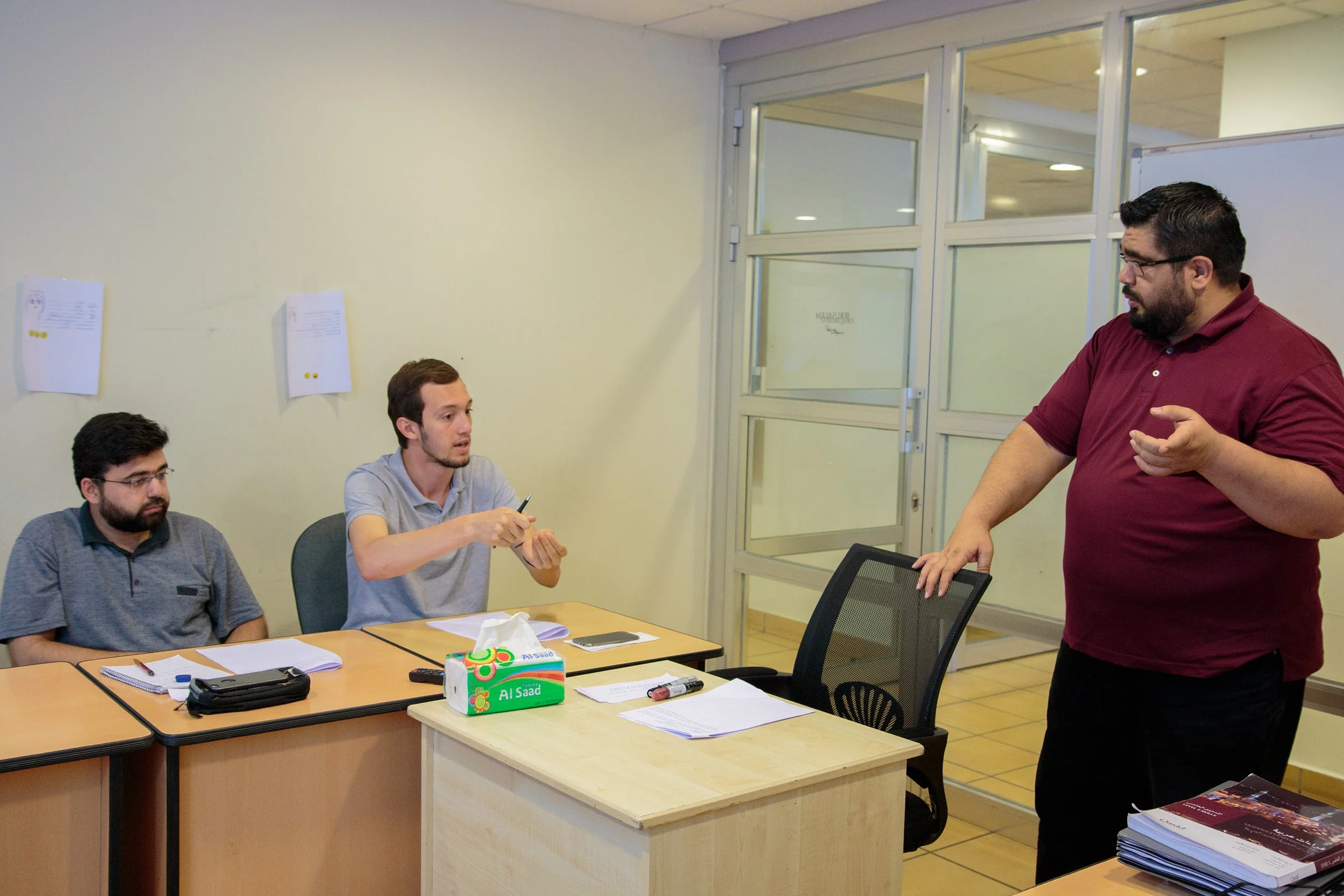
One of the most persistent mistakes in Arabic study is imbalance. Grammar receives disproportionate attention. Listening is undertrained. Speaking is postponed until the learner feels confident. Writing is treated either as an afterthought or as a source of anxiety. The result is a learner who has collected a great deal of knowledge about Arabic but has not yet built the skills to use it.
Serious Arabic learners train skills. A skill requires at least three things: a goal, a method, and feedback. You need to know what exactly you are practicing, how you are practicing it, and how you will know whether it improved. With that framework in mind, here is how to approach each of the four skills with the seriousness Arabic demands.
1. How to Improve Arabic Listening: Active Listening in Stages
Listening is not passive exposure. It is active meaning-building, combining what you hear with what you already know, while decoding sound and structure in real time. For most Arabic students, it is among the most psychologically demanding skills to develop, because the language does not slow down and it does not repeat itself for you.
The most important shift is from passive to staged active listening: approaching every listening task with a specific, pre-articulated goal, and working through that task in multiple passes, each pass with a different and progressively narrower objective.
-
Before pressing play, ask yourself: Who is speaking? What is the likely setting? What is the probable topic? What vocabulary or phrases might appear? It is the preparation that makes listening possible. Human comprehension is fastest when incoming language can attach to an existing mental frame. Think of context as fly paper on a wall. When it is in place, new information sticks. Without it, information bounces off. Students who skip this stage and dive directly into a listening passage are working harder for less.
-
On the first pass, your only goal is a broad orientation: the topic, the setting, the apparent purpose. Do not stop. Do not translate. Do not panic when words fly past you. If you catch only three words from a one-minute clip — say, Morsi, al-Sisi, and Egypt — you have already established "Egyptian politics" as your frame. In doing so, you have eliminated virtually everything else a human being could possibly be discussing. That frame is not a small thing. It is what makes the next pass possible.
-
Now the goal narrows. Return to the same passage with a specific target: a place, date, name, cause, sequence, or statistic. This kind of purposeful listening is far more cognitively productive than trying to understand everything at once, because it preserves working memory for the things that actually matter in this pass.
-
This is the most sophisticated of the three types, and it is where your cultural intelligence becomes a genuine asset. Consider this brief exchange:
Person A: "Look outside. We could go for a walk. Maybe play tennis." Person B: "Look out the window. It's raining." Person A: "Raining. Oh, no." (Helgesen & Brown, 1994)
Did they go outside? No. But neither person said so. We inferred it from tone, from context, from what was not said. This is the substrate of all real communication, and it is especially salient in Arabic. Whether a news outlet describes a certain act as عمليات استشهادية (ʿamaliyyat istishhadiyya - "martyrdom operations") or عمليات انتحارية (ʿamaliyyat intihariyya - "suicide missions") is not a neutral lexical choice. It encodes an entire political and ideological stance without ever stating it. The student who listens for inference catches this. The student focused only on vocabulary comprehension does not.
One discipline that changes everything: give each listening session one main question, not ten. A single question forces sharper, more productive attention. Match your evaluation to the goal you set and do not judge a gist task by whether you caught every word.
2. Reading: Train Both Directions at Once
Arabic reading improves fastest when you stop treating it as a single, undifferentiated activity. Researchers in reading pedagogy describe two broad orientations that skilled readers use in tandem. Bottom-up processing focuses on letters, morphology, syntax, and the lower-level decoding processes that build accurate comprehension. Top-down processing uses background knowledge, genre expectations, and prediction to generate and test hypotheses about meaning before engaging closely with individual words. The research is clear: strong readers use both, and the best approach is interactive moving between these two modes depending on what the text and the moment require.
This is good news for Arabic students on two counts. First, yes, you do need real lower-level control: rapid recognition of script, common morphological patterns, and high-frequency vocabulary. Second, you do not need to solve every word before you can begin understanding the text. You can and should read with hypotheses and partial comprehension that sharpen over successive passes. Here is a staged reading approach that puts both to work:
-
Before reading closely, scan the title, headings, opening sentences, repeated names, and discourse markers such as لكن، لأن، لذلك، من جهة أخرى (however, because, therefore, on the other hand). Identify the genre: is this a news report, an academic argument, an opinion piece, a literary text, a legal document, or a devotional passage? Genre shapes everything that follows.
-
Read without stopping at every unfamiliar word. Accept ambiguity for now. Ask: what is the writer doing here? What is the central claim? Where is the contrast? Which sentence turns the paragraph?
-
Now slow down. Identify verbs and their subjects. Track pronoun reference. Mark connectors and logical relationships. Notice recurring morphological patterns and collocations. Work on the syntax.
-
Write a one-sentence summary. Pull out three key terms and two connectors. Retell the paragraph aloud. This output step is the one most students skip, and it is the one that turns recognition into retrieval. Without it, reading trains comprehension. With it, reading trains language.
A common and destructive reading trap is making every text a grammatical autopsy, dissecting each sentence so thoroughly that the text stops being language and becomes a series of parsing exercises. Serious learners alternate intensive and extensive reading across the week: some texts get close attention; others are read for flow, volume, and confidence. Both are necessary.
On tools: A physical dictionary like Hans Wehr's A Dictionary of Modern Written Arabic remains superior to machine translation for a practical reason. When you look up a word in a physical dictionary, you engage in a multi-step cognitive process: you search, you read multiple entries, you make a judgment about which meaning fits your context, and you return to the text. That process is linguistically rich, and it creates memory. Machine translation collapses all of that into a single click, producing a word your brain has no particular reason to retain. The difficulty of the dictionary is not an argument against it. It is the mechanism of its effectiveness.
3. Writing: The Skill That Trains All the Others
Of all four skills, writing is the one most consistently undervalued by Arabic students, and the one that will do the most for your overall development if you take it seriously. Many students treat writing as a test. In reality, writing is a tool for thinking, and that distinction changes everything about how it should be used.
The educational theorist James Britton identified three broad types of writing that remain pedagogically useful. Transactional writing communicates information to an audience: arguments, reports, explanations. Poetic writing crafts aesthetic or literary objects from language. Expressive writing is the third and most important category for language learners: it is exploratory and reflective, used as a means of thinking through ideas rather than displaying fully formed ones.
Expressive writing is the missing category in most Arabic study routines. It is not writing to perform competence before an audience, it is writing to discover what you can say and what you cannot yet say. When you write expressively in Arabic, you cannot fake it. Every sentence forces a decision: the right verb, the right preposition, the right register, the right word order. You are reaching constantly into your vocabulary, your grammar, your intuition about how the language moves, and producing something that either works or reveals a gap. Both outcomes are valuable. Research associated with Swain's output hypothesis argues that this kind of production forces learners to notice the gaps that input alone never surfaces, gaps that then become specific, actionable learning targets.
One of the most effective techniques for generating expressive writing is the point-of-view guide. Before writing a dialogue or scene, ask yourself deliberately: Who is speaking? What register fits this speaker and this situation? What phrases would this person naturally use? What would sound too formal, too casual, or simply wrong? This trains genre and register awareness alongside grammatical correctness, which is what real-world Arabic use actually requires.
Taking this further: Instead of writing a journal from your own daily experience, choose a figure you admire, a historical character, a social role you don't occupy (like a journalist, a merchant, a host, a traveler, or a scholar) and write their journal. Step into a life more eventful or more demanding than your own. What this produces, unexpectedly, is vocabulary hunger. When you are writing from inside a compelling imagined experience, you will reach for words you don't yet have. You will need to express ideas you don't yet know how to express. Those moments of genuine linguistic need are among the deepest sites of vocabulary acquisition. A word you had to find because you needed it to say something you cared about takes root in a way that a memorized list item never does.
Writing rhythm: Three times a week, write six to ten sentences of expressive writing consisting a summary of something you read or heard, a retelling of a passage from a different perspective, a short dialogue using target vocabulary. Once a week, write one more transactional piece worth revising rather than merely completing. Keep a running error-and-correction list, but track only recurring patterns. Mistakes that recur are what needs direct attention.
The larger claim is worth stating plainly: writing in Arabic will make you better at every other skill. It sharpens your reading, because you begin to notice how skilled writers construct sentences you are also trying to construct. It improves your listening, because grammatical structures you have labored over in writing become auditory patterns you recognize. It strengthens your speaking, because you have already rehearsed the thought and already found the word. Writing is not one skill among four. It is the crucible in which the other three are forged.
4. Speaking: Use Input to Prepare Output
Speaking is the skill Arabic students most want and most fear. The fear is understandable: speaking is the most publicly exposed of the four skills, the least forgiving of hesitation, and the most vulnerable to the social discomfort of imperfection. But the fear, left unaddressed, becomes a structural impediment. Because speaking is also the skill most dependent on volume of practice, which requires putting yourself into situations where you are not yet comfortable.
One of the most reliable principles for improving Arabic speaking is this: use input to prepare output. Listen first, then speak about what you heard. Read first, then summarize aloud. Collect phrases from a text or audio clip, then reuse them in conversation. This is not artificial scaffolding. Much of what sounds like spontaneous, fluent speech is actually prepared language recombined in real time. The more prepared language you have, the more natural your spontaneity becomes.
A parallel principle is to lower the cost of speaking. For many adults, speaking feels expensive as it costs embarrassment, slowness, and visible mistakes. The solution is not to reduce the cost by avoiding speaking; it is to reduce it by entering conversations more prepared. Before any anticipated Arabic interaction, build out your relevant topical vocabulary: family, work, study, travel, condolences, daily routine. Guide the conversation toward what you can actually do. The learner who stays in Arabic longer by navigating toward familiar terrain is doing more language work than the one who falls silent in unfamiliar territory.
Arabic-speaking cultures have rich traditions of formalized exchange, مجاملة (mujamala - social courtesies and pleasantries), that structure how interactions open, flow, and close. These are not decorative features of the language. They are load-bearing structures, and knowing them frees cognitive energy for actual communication. When a Jordanian host's gathering ends and you finish your small coffee cup (فنجان, finjan), the expected exchange is دائماً (da'iman - "Always," wishing that the gathering always recur), met with بوجودك (bi-wujudak - "With your presence"). But visit that same host when he is ill, and the schema changes. Saying da'iman in that context would imply wishing that he always remain unwell. The appropriate formula becomes بالأفراح (bil-afrah - "With joys"), wishing him a return to health. Same host, same coffee but entirely different social meaning. Students who know these schemas preserve their cognitive resources for real communication. Students who don't spend those resources trying to decode what should be automatic.
Build what might be called micro-scripts for the recurring domains of your Arabic-speaking life: the language of a host visit, a café order, a condolence, a congratulation, a seminar discussion, a polite request for repetition, a graceful exit. These are compact interactional maps, internalized well enough to run automatically, freeing attention for the parts of the conversation that actually require thought. Once these scripts stop feeling like scripts and start feeling like available language, willingness to communicate stops being a question of courage and becomes a question of readiness.
Finally: self-assess, but do not obsessively compare. The relevant question is never whether your Arabic is better than the most fluent person in the room. It is whether your Arabic today is stronger than your Arabic last month. Strong learners monitor themselves closely, but they do not convert every interaction into a referendum on their ability. Their goal is to remain in the game long enough for the language to change them.
Part Three: How to Memorize Arabic Vocabulary So It Becomes Usable

1. The Three Layers of Vocabulary Ownership
Vocabulary is the substrate of everything else. Without sufficient lexical range, your listening comprehension stalls, your reading slows to a crawl, your writing stays within painfully narrow limits, and your speaking relies on the same twenty words cycling through every sentence. Expanding your vocabulary is not optional. The question is how to do it effectively.
Research synthesized by Paul Nation and others argues that deliberate study, especially from word cards, can be efficient and effective, and that a program combining deliberate learning with meaningful exposure outperforms one relying on incidental acquisition alone. At the same time, Nation and his colleagues are explicit: learning from word cards does not mean a word is learned forever. Form-meaning links are only the beginning. Full command of a word knowing its register, its typical collocations, its syntactic behavior, the contexts in which it sounds natural comes only through repeated, varied, meaningful use.
A useful way to think about vocabulary growth is in three layers:
A) Deliberate learning: Using cards, organized lists, and efficient acquisition techniques to get words into accessible short-term memory. This is the front door.
B) Chunking: Learning words not in isolation but in the meaningful phrases and collocations in which they actually occur. This is where words gain behavioral knowledge on how they travel, what they attract, what they resist.
C) Usage: Recycling words and phrases across all four skills: hearing them in listening, encountering them in reading, deploying them in writing, and retrieving them in speech. This is what converts memorization into ownership. Students who skip this third layer find that vocabulary stays brittle. It is present on the flashcard but absent when needed.
2. Chunking: Learn Language as Language Actually Moves
One of the most powerful principles in vocabulary pedagogy is chunking, learning language not as isolated units but in the meaningful combinations in which it actually occurs.
The linguist Alison Wray's work on formulaic sequences argues that successful language use depends heavily on mastery of multiword strings: collocations, sentence frames, and formulaic expressions. This is one reason near-native fluency cannot be built from dictionary items alone. Languages are full of words that habitually travel together, and the learner who studies only individual items risks knowing many words without knowing how the language actually moves.
The classic illustration: "make yourself at home." Breaking it into its grammatical components such as an imperative verb, a reflexive pronoun, and an adverbial phrase is technically correct but practically useless. No one has ever made a guest feel welcome through grammatical analysis. The phrase works only as a whole unit, grasped in context, attached to the social situation it belongs to. The same logic governs hundreds of everyday expressions: we say "strong tea" and "heavy rain" and not "powerful tea" or "strong rain." These are conventions encoded in chunks, and they must be learned as chunks.
Arabic operates the same way. When al-Kitab introduces the verb حَصَلَ (hasala), it teaches it as حَصَلَ عَلَى (hasalaʿala - "to obtain or receive something") in the context of a شهادة (shahada - degree). That is a chunk: verb, preposition, and typical object in a real-world frame. The preposition is not a separate item to memorize alongside the verb. It is part of the unit.
For Arabic specifically: store verbs with their habitual prepositions, nouns with their common adjectives, sentence openings with their typical continuations, and social formulae as whole expressions. Use Arabic's extraordinary root system as an organizing tool for insight and pattern recognition. Recognizing that ك-ت-ب underlies كَتَبَ, كِتَاب, مَكْتَبَة, and كَاتِب gives you a productive mental map. But a root is not a guarantee of knowing how a derived word behaves in authentic usage: what register it belongs to, what it sounds like in real sentences, what it collocates with. Morphology gives you families. Chunks give you speed. Successful learners build both.
3. The Piling Method: Keeping Vocabulary Alive
The most persistent challenge in vocabulary acquisition is not learning new words, it is keeping old ones alive long enough to use them meaningfully. The typical student memorizes Monday's vocabulary on Monday, Tuesday's on Tuesday, and finds by Thursday that Monday's words have largely faded. The piling method is a practical, low-tech system for addressing this.
Cognitive research on spaced repetition shows that memory strengthens when learners actively recall information and when review is distributed over time rather than massed into a single session. The piling method operationalizes this. Rather than treating each day's vocabulary as an independent event, you maintain a rolling stack of review piles that extend your engagement with each set over multiple days.
Each day, memorize a new set of cards in both directions: Arabic to English and English to Arabic. Before starting the next day’s set, quickly review the previous day’s cards. As the days continue, keep older piles in light rotation while giving newer piles closer attention. This adds only 15–20 minutes to your routine, but the effect is substantial: instead of remembering only the most recent words, you build a growing vocabulary bank that stays active and accessible.
A note on format: Start with physical flashcards. Write the words by hand, sort the cards yourself, and handle them often. The physical act matters: it gives the vocabulary a tactile and spatial anchor. Apps like Anki can come later as a useful review tool, but the first layer of memory should be built by hand.
Build a Use Pipeline
Vocabulary becomes language only when it moves into use. Each week, choose ten words or chunks and push them through all four skills: notice them in listening, mark them in reading, use them in writing, and bring them into speech. This is how memorized vocabulary becomes owned vocabulary.
A Practical Study Architecture for the Serious Learner
All of this can sound overwhelming until it is organized. The goal is not to study everything at heroic intensity every day. The goal is to balance the major strands of learning so that progress in one skill feeds the others, and Arabic stays warm enough, through regular contact, to keep developing.
Research on language pedagogy identifies four essential components of a well-designed routine:
(1) meaningful input, (2) meaningful output, (3) focused language study, and (4) fluency practice.
A sustainable weekday block for a university student might look like this:
8–12 minutes: Vocabulary retrieval
Review new cards and older piles, focusing on phrases rather than isolated words.8–12 minutes: Input practice
Work through one listening clip or reading passage in at least two stages.3–8 minutes: Output practice
Write six expressive sentences, or record a short spoken summary on your phone.One live or semi-live contact point
Send a message, join a brief exchange, or have a short conversation in Arabic and try to stay in the language slightly longer than comfort allows.
Twice a week, extend one session for a genuine intensive reading and one real speaking session, followed by notes on what you couldn't say and needed. Once a week, spend fifteen minutes reviewing: What improved? What blocked you? What recurring error appeared? What situations required language you didn't yet have? This kind of reflection turns scattered effort into a planned ecology of learning.
A workable system, consistently executed, will always outperform an impressive plan that never becomes real.
Closing: The Horizon Mindset
A useful image for Arabic progress is the horizon at dawn. Imagine it as light spreading across a broad horizon with depth and range. Arabic is a long project. The learners who succeed are rarely the ones with the most dramatic routines or the most intense initial commitment. They are the ones who build a system that survives real life — clear goals, steady contact hours, active listening, purposeful reading, low-stakes writing, brave speaking, and vocabulary learned as usable language rather than inert inventory.
The students who retain Arabic are those who guessed, risked, noticed, recycled, and returned. They learned to listen for gist before detail, to read for structure before translation, to write in order to think, to speak before certainty arrives, and to treat every interaction, in and out of the classroom, as a site of learning. Over time, Arabic ceases to be a subject they visit and becomes a medium they increasingly inhabit.
That is when the language begins to open. And for a language as vast, as beautiful, and as intellectually alive as Arabic, that opening is worth every hour it takes.
This guide draws on a series of study-skills lectures developed at Qasid Arabic Institute and presented by its Director, Omar Matadar. The insights it contains, refined through years of teaching and advising serious Arabic learners, form the intellectual foundation of much of what is written here. We consider it a living document — one that will continue to grow as our understanding deepens.
References
Britton, J. (1975). The development of writing abilities (11–18). Macmillan.
Helgesen, M., & Brown, S. (1994). Practical English language teaching: Listening. McGraw-Hill.
Nation, I. S. P. (2001). Learning vocabulary in another language. Cambridge University Press.
Rubin, J. (1975). What the "good language learner" can teach us. TESOL Quarterly, 9(1), 41–51.
Swain, M. (1985). Communicative competence: Some roles of comprehensible input and comprehensible output in its development. In S. Gass & C. Madden (Eds.), Input in second language acquisition (pp. 235–253). Newbury House.
Wray, A. (2002). Formulaic language and the lexicon. Cambridge University Press.